
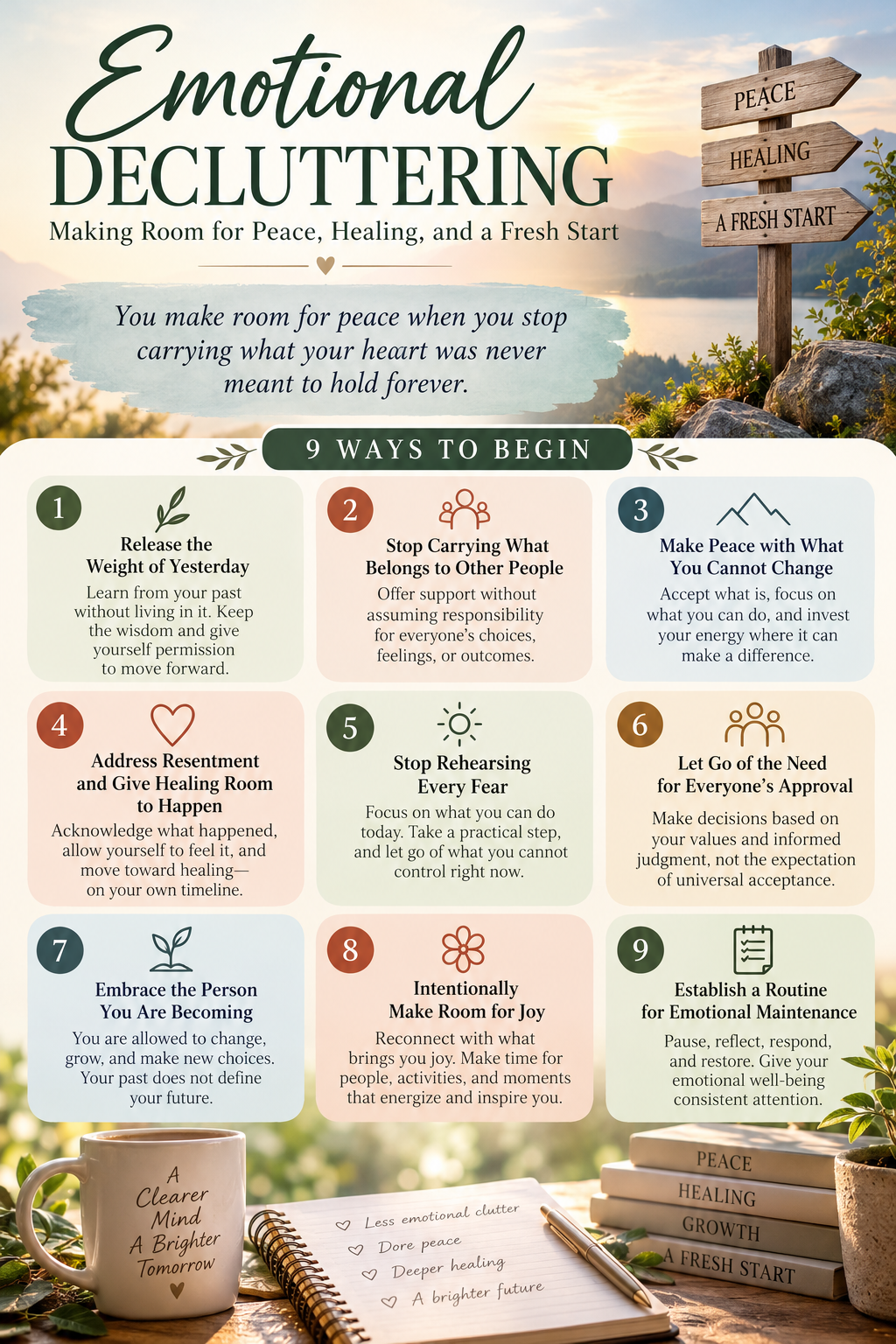
You make room for peace when you stop carrying what your heart was never meant to hold forever.
Have you ever walked into a room filled with clutter and felt overwhelmed before you even began to clean? Have you ever looked at your desk and not know where to look for something and felt confused just by looking at it? Or looking for something in your closet and felt defeated and tired not knowing where to find that shirt or dress.
Now imagine carrying that same clutter inside your body, heart and mind.
Unspoken disappointments. Old arguments. Regrets about decisions you cannot change. Resentment toward people who hurt you. Fear of what might happen tomorrow. The pressure to please everyone while neglecting yourself, and then the guilt that follows. Guilty for not taking better care of yourself, guilty for stretching yourself too thin just to please others, guilty for putting your projects on hold to help someone else complete theirs.
Just as physical clutter can make it difficult to find what you need, emotional clutter can make it difficult to find your peace.
We spend time organizing our homes, cleaning our closets and cupboards, deleting old emails, and getting rid of things we no longer use. We free up memory and space on our hard drives. Yet, how often do we pause to examine the emotional baggage we have accumulated along the way?
Emotional decluttering is the intentional process of identifying, processing, and releasing the emotional weight that no longer serves your well-being.
It is not about pretending that painful experiences never happened. It is not about suppressing your feelings or convincing yourself that everything is fine when it is not. It is about acknowledging what you feel, learning what you can from your experiences, and deciding what you are no longer willing to carry.
Sometimes, the fresh start you need begins within you.
- Release the Weight of Yesterday
One of the heaviest weights we carry is the past.
We replay conversations, revisit disappointments, and wonder what might have happened if we had made a different decision. We think about what someone should have done, what we should have said, or how we could have prevented a painful outcome.
But yesterday has already taken its place in your story.
You cannot rewrite the past, but you can change the amount of power it has over your present.
We make decisions with the knowledge we had at the time. We have all trusted someone who disappointed us. We have all stayed too long in a situation that was no longer healthy for us.
We need to give ourselves permission to acknowledge and learn the lesson without continuing to punish ourselves for the experience. We can’t live in a state of condemnation, it is not a healthy place to live.
We learn from our past, we don’t live there. Let yesterday teach you without allowing it to determine how you live today.
Take the lesson. Keep the wisdom. Release the unnecessary guilt. Don’t beat yourself up over it.
Your past may explain parts of your story, but it does not have to dictate the chapters that are your future, those yet to come.
- Stop Carrying What Belongs to Other People
Sometimes, our emotional clutter comes from carrying responsibilities that were never ours to bear.
We worry about everyone’s feelings. We try to fix everyone’s problems. We feel responsible for keeping everyone happy, even when doing so costs us our own peace, happiness and health.
We carry other people’s expectations, disappointments, opinions, and judgments as if they were our personal assignments.
But here is an important truth: You can care about people without carrying everything for them.
You are allowed to offer support without becoming responsible for every outcome. You can love someone without agreeing with every decision they make. You can be compassionate without sacrificing your boundaries.
Not everyone will understand our choices. Not everyone will approve of our growth. And not everyone will be comfortable when we stop making ourselves available at the expense of our own well-being.
That does not automatically mean we are doing something wrong.
Sometimes, emotional decluttering means learning to say no without writing a lengthy explanation. No, is a complete sentence. Sometimes, it means stepping back from unnecessary conflict. And sometimes, it means recognizing that another person’s reaction is theirs to manage.
You are responsible for how you show up in the world, not for controlling how everyone responds to you.
- Make Peace with What You Cannot Change
I have worn a Serenity Prayer bangle for more than 10 years, it says, “God, grant me the serenity to accept the things I cannot change, the courage to change the things I can, and the wisdom to know the difference.” Reinhold Niebuhr.
A tremendous amount of emotional energy is spent fighting reality. We wish people had treated us differently. We wish circumstances had worked out another way. We wish opportunities had not passed us by or relationships had not ended.
It is natural to grieve what we hoped would happen. But there comes a point when we must distinguish between what we can influence and what we must learn to accept.
Acceptance does not mean approval. It does not mean that what happened was fair, right, or deserved. It means acknowledging that something is part of your reality so you can decide how to move forward.
You may not be able to change what someone said, but you can decide how you respond. You may not be able to undo a missed opportunity, but you can prepare for the next one.
You may not be able to change someone’s character, but you can choose the boundaries that protect your peace.
When you stop spending all your energy trying to change what is beyond your control, you create room to work on what is within your reach.
Peace often begins when the struggle to control everything finally ends.
- Clear Out Resentment, One Layer at a Time
Resentment can take up an enormous amount of emotional space.
It can begin with a legitimate hurt, a broken promise, an unfair situation, or a betrayal. If that hurt remains unaddressed, it may grow into bitterness that follows us into new relationships and experiences. There is a difference between feeling disappointment and bitterness. We all have felt and been disappointed. The difference is disappointment is temporary, while bitterness if left unchecked is long lasting.
We may find ourselves expecting new people to repeat old patterns. We may become guarded, suspicious, or emotionally unavailable because we are still protecting wounds from the past.
Healing requires us to acknowledge those wounds honestly.
You do not have to minimize what happened. You do not have to reconcile with someone who harmed you. You do not have to restore access to your life simply because you are working toward forgiveness.
Forgiveness is not the same as excusing behavior. It can be a gradual process of loosening the hold that an injury or a hurt has on your emotional life.
Sometimes, the most important step is grieving what you deserved but did not receive.
You may need to acknowledge that an apology never came, that someone may never take responsibility, or that a relationship will never become what you hoped it would be.
That realization hurts. Allow yourself to feel it.
Then, when you are ready, begin to release the expectation that your healing must depend on someone else’s willingness to make things right.
Don’t anchor your peace waiting for someone else’s apology, you may never get it.
- Stop Rehearsing Every Fear
Not all emotional clutter comes from the past. Some of it comes from the future we keep imagining. The future we keep dreading.
What if I fail? What if things do not work out? What if I make the wrong decision? What if I lose what I have worked so hard to build?
Planning for the future is responsible. Living through every possible disaster before it happens is exhausting, mentally and physically.
Fear often invites us to believe that constant worrying will somehow protect us from disappointment. We imagine that if we think through every scenario, we will be prepared for everything.
But worry cannot guarantee an outcome.
It can, however, consume the energy you need to respond to the present. There is a Bible verse that says, “Jesus taught in the Sermon on the Mount, “Therefore do not worry about tomorrow, for tomorrow will worry about itself. Each day has enough trouble of its own”. Matthew 6:34
Worrying about tomorrow robs you of today’s peace without it being able to change what happens in the future.
When you notice yourself spiraling into anxious thoughts, pause and ask:
- Is this something I know, or something I fear?
- Is there an action I can take right now?
- Am I preparing for a possibility, or repeatedly punishing myself with it?
- What deserves my attention in this moment?
If there is something you can do, take a reasonable step. If there is nothing you can do right now, practice bringing your attention back to the present.
You do not have to solve tomorrow’s problems today.
Sometimes, the most productive thing you can do is breathe, pray, rest, and trust yourself to handle the next step when it arrives.
- Declutter the Need for Everyone’s Approval
One of the most exhausting emotional burdens is the need to be understood, accepted, and approved of by everyone.
We explain ourselves repeatedly. We second-guess our decisions. We soften our boundaries because we do not want to disappoint anyone. We change our preferences, silence our opinions, and make ourselves smaller to avoid criticism.
Over time, we can become so focused on meeting other people’s expectations that we lose touch with our own values. We lose touch with who we are at our core.
You were not created to spend your entire life auditioning for acceptance.
You can be a good person and still disappoint someone. You can make a thoughtful decision and still be misunderstood. You can be committed to growth and still receive criticism.
Not every opinion deserves equal weight in your life.
Listen to constructive feedback. Take responsibility when you are wrong. Remain open to learning. But do not confuse every person’s disapproval with evidence that you have failed.
Give yourself permission to make decisions that align with your values, even when those decisions are not universally celebrated.
You do not need everyone’s permission to become the person you are meant to be.
- Let Go of the Version of Yourself You Have Outgrown
Sometimes, the person we struggle to release is the person we used to be.
Perhaps you were the person who always said yes. Perhaps you were the one who kept the peace at any cost. Perhaps you accepted less than you deserved because you were afraid of being alone or starting over.
Maybe you made mistakes. Maybe you tolerated things you would no longer accept. Maybe you spent years trying to prove your worth.
You can acknowledge those experiences without allowing them to define who you are today.
Growth requires room to change and giving yourself grace.
You are allowed to develop new priorities, establish stronger boundaries, reconsider old beliefs, and pursue a different direction. You are allowed to become more confident, more discerning, and more protective of your time and energy.
Do not let shame keep you attached to a version of yourself that you have worked hard to outgrow.
Thank the person you were for surviving, learning, and getting you this far. Then give yourself permission to continue evolving.
You are not betraying your former self by growing beyond your old patterns. You are honoring the lessons that brought you here.
- Make Room for Joy, Gratitude, and New Possibilities
Emotional decluttering is not only about releasing what hurts. It is also about making room for what nourishes us.
When our minds are consumed by disappointment, resentment, and worry, we can overlook the small, meaningful things that make life worthwhile.
A quiet morning. A good conversation. A moment of laughter. A new opportunity. A peaceful evening. The comfort of being around people who allow you to be yourself.
These moments matter.
Begin paying attention to what restores you.
Spend time with people who encourage your growth. Make space for hobbies that bring you joy. Take care of your body. Protect your rest. Celebrate progress that no one else may notice.
Practice gratitude without using it to dismiss your pain. You can be grateful for what you have and still acknowledge what hurts. You can appreciate your life while working toward something better.
Both things can be true.
As you release the emotional weight you have been carrying, intentionally invite something positive into the space you create.
Replace self-criticism with self-compassion. Replace constant comparison with appreciation for your own journey. Replace the habit of expecting disappointment with a willingness to remain open to possibility.
You deserve more than a life spent recovering from what went wrong. You deserve the opportunity to experience what can go right.
- Create an Emotional Decluttering Routine
Just as your home requires regular maintenance, your emotional well-being benefits from regular attention.
You do not have to resolve every hurt in a single day. You do not have to force yourself to forgive before you are ready. And you do not have to make dramatic changes to begin feeling a difference.
Start small. Be honest with yourself. Give yourself room to process.
Here is a simple practice you can use at the end of each day or whenever life feels emotionally overwhelming.
Pause. Reflect. Release. Refill.
Pause: Slow down long enough to notice how you are feeling. Give yourself permission to stop performing, pleasing, and pushing for a moment.
Reflect: Ask yourself what is weighing on you. Is it a disappointment, an unresolved conversation, a fear, a boundary you need to establish, or an expectation you need to reconsider?
Release: Identify one thing you can begin letting go of. Perhaps it is the need to control an outcome, the habit of criticizing yourself, or the belief that you must fix everything for everyone.
Refill: Replace that emotional weight with something life-giving. Choose rest, prayer, journaling, a meaningful conversation, a walk, exercise, gratitude, or a practical step toward resolving the issue.
If an experience continues to cause significant distress, consider speaking with a qualified mental health professional. You do not have to navigate every difficult emotion alone. Therapy works!
Remember, the goal is not to become a person who never feels sadness, anger, disappointment, or fear.
The goal is to develop a healthier relationship with your emotions so they can be acknowledged and understood without controlling every part of your life.
Finally, Give Yourself Permission to Put It Down
Imagine what it would feel like to wake up without mentally revisiting yesterday’s disappointments.
Imagine no longer feeling responsible for everyone’s happiness.
Imagine making decisions without constantly worrying about who might disagree.
Imagine accepting that some questions will remain unanswered, some relationships will end, some opportunities will pass, and some chapters will close without the explanation you wanted.
Imagine choosing to move forward anyway.
That is the invitation of emotional decluttering.
It is an invitation to stop treating every disappointment as a permanent residence, every mistake as a life sentence, and every difficult experience as something you must carry forever.
You can acknowledge the hurt without allowing it to become your identity. You can remember the lesson without reliving the pain every day. You can honor what you have been through while making room for something new.
And remember, decluttering is not a one-time event. Some things must be released repeatedly. Some wounds take time to heal. Some days you will feel lighter, and other days you may discover another layer that needs attention.
Be patient with yourself.
You do not have to clear everything out today. You only have to be willing to begin.
Start with one thought. One boundary. One honest conversation. One moment of forgiveness toward yourself. One decision to stop carrying something that is draining your spirit.
Your body, heart and mind deserve the same care you give to the spaces you live in.
You cannot always control what life brings to your doorstep, but you can learn to choose what you continue to carry within you.
Release what you can. Process what you must. Protect what matters. And make room for peace.
Because sometimes, the most beautiful new beginning is not about adding more to your life.
It is about finally letting go of what no longer belongs there.
Today, give yourself permission to put it down.