
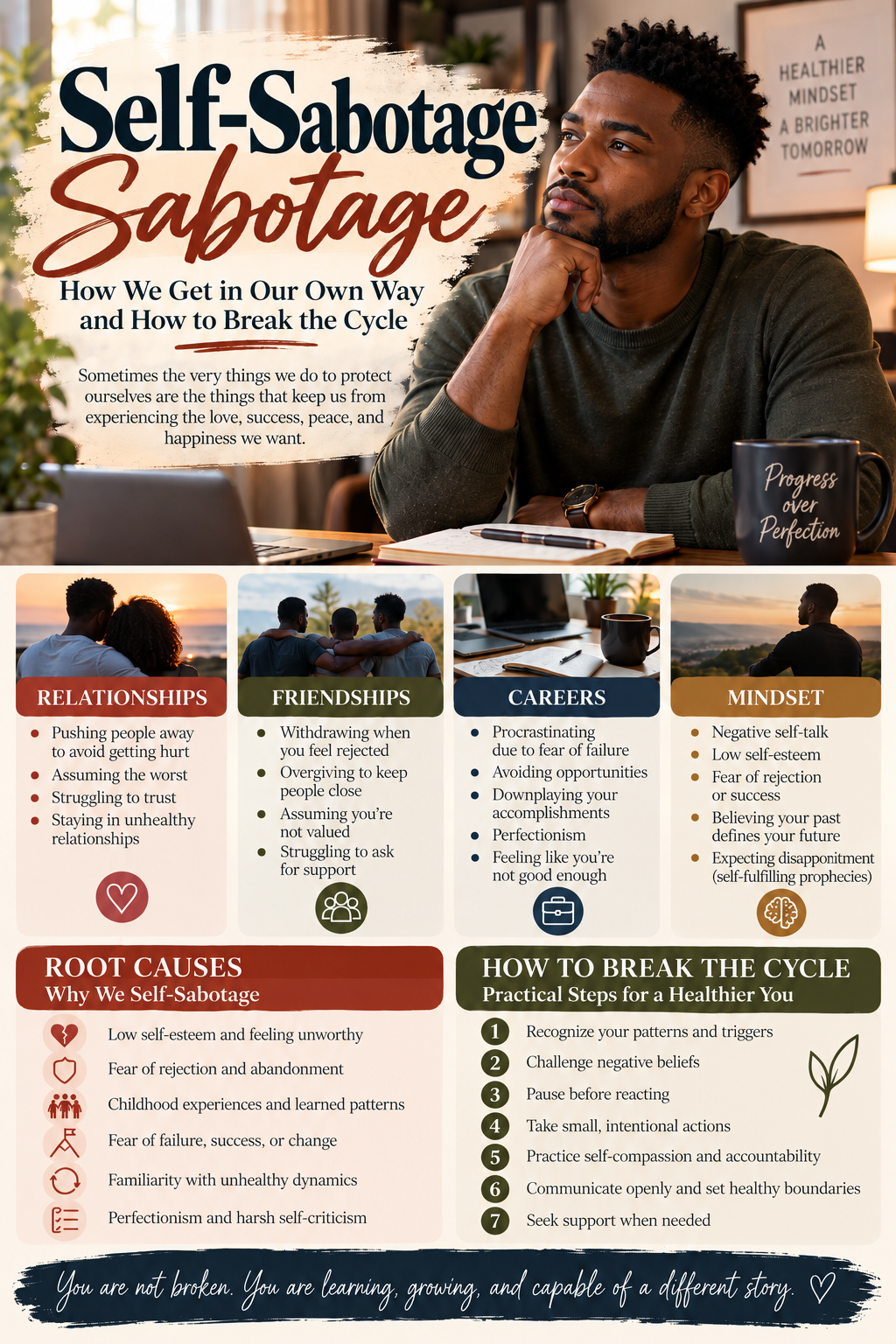
 Understanding the Fear, Patterns, and Unconscious Behaviors That Keep Us From Embracing the Life We Say We Want.
There is something deeply confusing about watching yourself work so hard for something, finally get it, and then find yourself doing things that threaten to destroy it.
You pray for the opportunity, but when it arrives, you question whether you are ready. You want a healthy relationship, but when someone genuinely loves you, you become distant, suspicious, or emotionally unavailable. You work toward success, but just when things begin falling into place, you procrastinate, lose focus, create unnecessary conflict, or make decisions that move you backward.
Why do we sometimes become our own biggest obstacle when life is finally going in the direction we wanted?
The uncomfortable truth is that sometimes we are more comfortable with what is familiar than with what is healthy, fulfilling, or good for us.
And that is where self-sabotage begins.
What Is Self-Sabotage?
Self-sabotage is when our thoughts, behaviors, decisions, or unconscious patterns interfere with our own goals, happiness, relationships, opportunities, or personal growth.
It is the process of doing things that work against what we consciously say we want.
What makes self-sabotage particularly complicated is that we are not always aware that we are doing it. Sometimes we recognize the behavior but struggle to understand why we keep repeating it.
We may genuinely want peace but repeatedly entertain chaos. We may desire stability but gravitate toward unpredictable relationships. We may want financial independence but consistently make decisions that undermine our financial goals.
The contradiction between what we want and what we do is often where the real work begins.
Why Do We Self-Sabotage When Things Are Going Well?
There are several psychological and emotional reasons we may find ourselves disrupting the very things we want.
- We Are More Comfortable With Familiar Pain Than Unfamiliar Peace
One of the biggest reasons people self-sabotage is that familiarity can feel like safety, even when what is familiar is unhealthy.
If you grew up around conflict, instability, criticism, rejection, or inconsistency, a peaceful environment may initially feel uncomfortable. You may be comfortable in disfunction as that is all you have known and function actually feels uncomfortable as it is not familiar.
You may find yourself questioning why everything is so quiet. You may anticipate something going wrong because, historically, good moments were often followed by disappointment.
In relationships, this can look like mistrusting someone who treats you well because you are accustomed to having to earn affection or fight for attention.
In professional environments, it can look like feeling uncomfortable when you are finally recognized, respected, and given opportunities to lead.
Sometimes we do not sabotage good things because we do not want them. We sabotage them because we have not learned how to feel safe experiencing them.
- Fear of Success Can Be Just as Powerful as Fear of Failure
We talk frequently about the fear of failure, but rarely do we discuss the fear of success.
Success brings responsibility, visibility, expectations, accountability, and change. It can also mean outgrowing familiar environments and relationships.
What happens when you actually get the promotion you wanted? What happens when your business becomes successful? What happens when you finally enter a healthy relationship?
You may begin wondering:
- What if I cannot maintain this?
- What if people expect more from me?
- What if I disappoint everyone?
- What if I am not as capable as people think?
- What if success changes my relationships?
Sometimes we unconsciously create obstacles because staying where we are feels less frightening than stepping into an unfamiliar level of responsibility.
We may want the results of success without fully confronting the changes that success requires.
- We Do Not Believe We Deserve Good Things
Low self-worth can quietly influence the decisions we make.
When someone does not believe they are worthy of love, respect, happiness, or success, they may struggle to receive those things without questioning them.
They may tolerate mistreatment because they do not believe they deserve better. They may reject genuine affection because they cannot understand why someone would love them. They may minimize their accomplishments because they do not believe they are particularly deserving of recognition.
Sometimes the problem is not that good things are unavailable. It is that we have not developed the internal belief that we are worthy of experiencing them.
There is a difference between wanting something and believing you deserve to have it. Until those two things begin to align, we may continue making choices that contradict our desires.
- We Are Afraid of Being Vulnerable
Good relationships require vulnerability. Meaningful friendships require trust. Professional growth requires being willing to take risks and sometimes admit what we do not know.
But vulnerability means allowing ourselves to be seen.
For someone who has experienced betrayal, abandonment, rejection, or disappointment, vulnerability can feel dangerous.
Rather than risk being hurt again, we may:
- Push people away before they can get close.
- Find flaws in someone who is treating us well.
- Avoid difficult but necessary conversations.
- Refuse to ask for help.
- Keep our emotions hidden.
- End relationships before they have an opportunity to develop. Often because of the minutest detail, like, the person has a stray eyebrow hair (extreme example I know).
Now, we know that could easily be fixed, but rather than look at it as a small insignificant detail, we blow it up as an excuse to end things. The mindset is, leave them before they leave me”. So, we make any little detail the focus to put an end to things.
We convince ourselves that we are protecting our peace, when sometimes we are protecting ourselves from the possibility of being hurt.
There is a difference between having healthy boundaries and building emotional walls so high that nothing meaningful can reach us.
- We Have an Unresolved Relationship With Our Past
Unresolved experiences can influence how we respond to present circumstances.
Childhood experiences, previous relationships, professional disappointments, betrayal, rejection, and periods of instability can shape our beliefs about ourselves and the world.
Sometimes we carry those experiences into situations that have nothing to do with the original pain.
For example, someone who was repeatedly criticized growing up may struggle to accept constructive feedback at work. Someone who has experienced abandonment or betrayal may interpret a partner’s need for personal space as rejection. Or may indulge in destructive behaviors like substance abuse or infidelity.
We may be responding to the present through the emotional lens of the past.
The danger is that we begin treating new people, opportunities, and experiences as though they are responsible for things someone else did to us.
Healing requires recognizing when our reactions are connected to an old wound rather than the situation directly in front of us.
- We Confuse Chaos and Drama With Excitement
Some people become so accustomed to emotional unpredictability that stability feels boring.
They may mistake emotional highs and lows for passion, conflict for connection, and uncertainty for excitement.
In relationships, this can mean repeatedly choosing people who are emotionally unavailable or inconsistent because the pursuit feels familiar.
Professionally, it can mean constantly creating urgency, taking on unnecessary responsibilities, or becoming involved in workplace drama because calm and consistency feel unfamiliar.
But not everything that is exciting is healthy, and not everything that is peaceful is boring.
Sometimes the most meaningful growth happens when we learn to appreciate consistency instead of constantly searching for stimulation.
What Does Self-Sabotage Look Like in Everyday Life?
Self-sabotage does not always look dramatic. Sometimes it appears in subtle, repetitive behaviors that slowly undermine our progress.
In relationships:
- Creating arguments over insignificant issues.
- Testing someone’s love instead of communicating our needs.
- Becoming emotionally unavailable when intimacy increases.
- Returning to relationships we already know are unhealthy.
- Rejecting healthy connections because they feel unfamiliar or deemed as boring.
In our careers:
- Procrastinating on important assignments.
- Avoiding opportunities because we fear being exposed as inadequate.
- Refusing to advocate for ourselves.
- Allowing insecurity to interfere with professional relationships.
- Failing to follow through on opportunities we worked hard to obtain.
In our personal lives:
- Making commitments and repeatedly failing to honor them.
- Abandoning healthy routines when progress begins.
- Overspending despite financial goals.
- Talking ourselves out of opportunities.
- Constantly comparing ourselves to others.
- Allowing negative self-talk to determine what we believe is possible.
One isolated mistake does not automatically mean self-sabotage. The concern is when the same behaviors repeatedly appear and interfere with the life we are trying to build.
How Do We Stop Self-Sabotaging?
The goal is not to become a person who never makes mistakes, experiences fear, or has moments of uncertainty. The goal is to become more aware of our patterns so that our reactions no longer control our decisions.
- Recognize Your Patterns
Start paying attention to what happens when things are going well.
Do you become anxious? Do you suddenly lose motivation? Do you start questioning people who have demonstrated that they are trustworthy? Do you find reasons to abandon something you previously worked hard to achieve?
Ask yourself:
- What do I consistently do when I feel happy, successful, or secure?
- What situations trigger my need to withdraw, escape, or create conflict?
- What patterns keep showing up in my relationships and decisions?
- What am I afraid might happen if things actually work out?
Awareness is the first step toward changing a behavior you may have been repeating for years.
- Learn to Sit With Discomfort
Not every uncomfortable feeling is a warning sign.
Sometimes discomfort is simply the experience of doing something differently.
A healthy relationship may feel unfamiliar. Being recognized for your accomplishments may feel uncomfortable. Setting boundaries may create anxiety. Allowing yourself to rest may feel unnatural if you have always associated your worth with productivity.
Learn to pause, breathe and think before reacting.
You do not have to run from every uncomfortable emotion or immediately act on every fearful thought.
Sometimes you need to allow yourself to experience something new without trying to control the outcome.
- Challenge the Stories You Tell Yourself
Our internal dialogue has tremendous influence over our behavior. If you repeatedly tell yourself that you are not good enough, that people always leave, that success never lasts, or that something will inevitably go wrong, those beliefs can begin influencing your decisions.
Challenge those assumptions.
Instead of saying, “I am going to mess this up,” consider, “I am learning how to navigate something new.”
Instead of saying, “Something must be wrong because things are going so well,” consider, “I am allowed to experience happiness without anticipating disappointment.”
Instead of saying, “I do not deserve this,” consider, “I can appreciate this opportunity and grow into the responsibility that comes with it.”
You cannot always control the thoughts that enter your mind, but you can learn to question whether they deserve to guide your behavior. There is a saying often attributed to Martin Luther, “you cannot keep birds from flying over your head, but you can keep them from building a nest. The same is with our thoughts.
- Stop Making Decisions From Fear
Fear often encourages immediate reactions.
It tells us to withdraw, run, reject, retaliate, or give up before we have had an opportunity to understand what is happening.
When you feel the urge to make a decision that could disrupt something positive, pause.
Ask yourself:
- Am I responding to something that actually happened?
- Am I reacting to something I fear might happen?
- Am I making this decision from clarity or insecurity?
- Will this decision move me closer to the life I want?
Sometimes the most powerful thing you can do is resist the urge to act on an emotion that will eventually pass.
- Address the Unresolved Issues
You cannot always change the past, but you can change how much influence it has over your present.
That may involve honest self-reflection, journaling, difficult conversations, establishing boundaries, or working with a qualified mental health professional.
If certain experiences continue influencing your relationships, confidence, or ability to trust, give yourself permission to explore them.
Healing is not about pretending something never happened. It is about reaching a point where what happened no longer dictates every decision you make.
- Practice Receiving Good Things
This may sound simple, but receiving can be difficult for people who are accustomed to struggling.
Practice accepting compliments without dismissing them. Accept help without feeling guilty. Allow people to show up for you. Celebrate your accomplishments without immediately minimizing them.
When something good happens, resist the urge to search for what could go wrong.
You do not have to earn the right to enjoy every positive experience through exhaustion, sacrifice, or struggle.
Sometimes you simply need to receive what you have worked and prayed for.
- Build Trust With Yourself
Every time you follow through on a commitment, honor a boundary, make a healthy decision, or resist an old pattern, you strengthen your relationship with yourself.
Start with small promises and keep them.
If you say you are going to complete something, complete it. If you decide to walk away from an unhealthy situation, honor that decision. If you commit to pursuing an opportunity, give yourself permission to try.
Self-trust is developed through consistent actions, not just positive affirmations.
The Difference Between Self-Sabotage and Self-Protection
It is important to recognize that not every decision to walk away, say no, change direction, or establish distance is self-sabotage.
Sometimes leaving a relationship is healthy. Sometimes declining a promotion is the right decision. Sometimes slowing down is necessary.
Self-protection is rooted in recognizing what is healthy for you and acting accordingly.
Self-sabotage often involves repeatedly undermining something you genuinely want because of fear, insecurity, unresolved experiences, or beliefs that may no longer serve you.
The distinction is important because we should never convince ourselves to remain in unhealthy circumstances simply because we are afraid of being accused of self-sabotage.
The objective is not to hold on to everything. It is to stop pushing away what is genuinely good for us.
Final Thoughts: You Do Not Have to Destroy What You Have Prayed For
One of the hardest things to acknowledge is that sometimes the obstacle standing between us and the life we desire is not another person, a lack of opportunity, or unfavorable circumstances.
Sometimes it is our own behavior.
We spend years asking for peace, but struggle when life becomes peaceful. We ask for love, but question it when someone offers it freely. We ask for opportunities, but retreat when they require us to step outside our comfort zone.
At some point, we have to ask ourselves whether we are truly prepared to embrace the very things we keep asking God to give us.
Are we willing to stop choosing familiar dysfunction over unfamiliar growth? Are we willing to release the beliefs that tell us we are undeserving? Are we willing to stop allowing yesterday’s disappointments to determine tomorrow’s possibilities?
You cannot change what happened to you, but you can begin changing the patterns you carry because of it.
And perhaps one of the most important parts of personal growth is learning that you do not have to live in survival mode when your life finally gives you an opportunity to thrive.
Stop preparing yourself for disappointment when life is giving you reasons to hope. Stop looking for the exit when you have finally found something worth building. Stop confusing peace with boredom, drama with excitement, love with vulnerability, and growth with danger.
You deserve to experience good things without feeling the need to question, sabotage, or destroy them.
You are allowed to be happy.
You are allowed to succeed.
You are allowed to be loved.
A few important reminders
- You cannot heal a pattern you refuse to acknowledge.
- Familiarity does not always mean safety.
- Not every uncomfortable feeling requires an immediate reaction.
- Your past may explain your behavior, but it does not have to dictate your future.
- You do not have to struggle to prove that you deserve happiness.
And most importantly, you are allowed to have a good life without feeling that something bad must be coming to take it away.
Stop Sabotaging the Life You’ve Been Praying For.
You are allowed to experience the goodness you worked so hard to create.